
Useful automation is not defined by a particular tool. It comes from understanding the operational problem, choosing suitable engineering practices, and building something a team can change, support, and improve.
SynEdgy combines deep PowerShell and infrastructure automation experience with the delivery practices needed to make that expertise useful in production.
Discuss your automation challenge
PowerShell engineering
PowerShell is at the centre of many business-critical automation systems, even when organisations still describe the work as a collection of scripts.
We help teams move from isolated scripts towards maintainable modules with clear dependencies, automated tests, consistent packaging, useful documentation, and repeatable release workflows.
Sampler is a public example of this approach. It provides reusable scaffolding and build automation for PowerShell projects and is used across established DSC Community repositories.
synedgy.PSSqlite demonstrates a different aspect of modern module engineering. It lets PowerShell applications define SQLite schemas and views in YAML, initialise and version the database, and use PowerShell-friendly CRUD helpers without hand-writing SQL for every operation. Direct SQL remains available when the abstraction is not enough.
The Modern PowerShell module Development conference session gives a practical introduction to the engineering decisions behind reusable modules.
PowerShell Universal
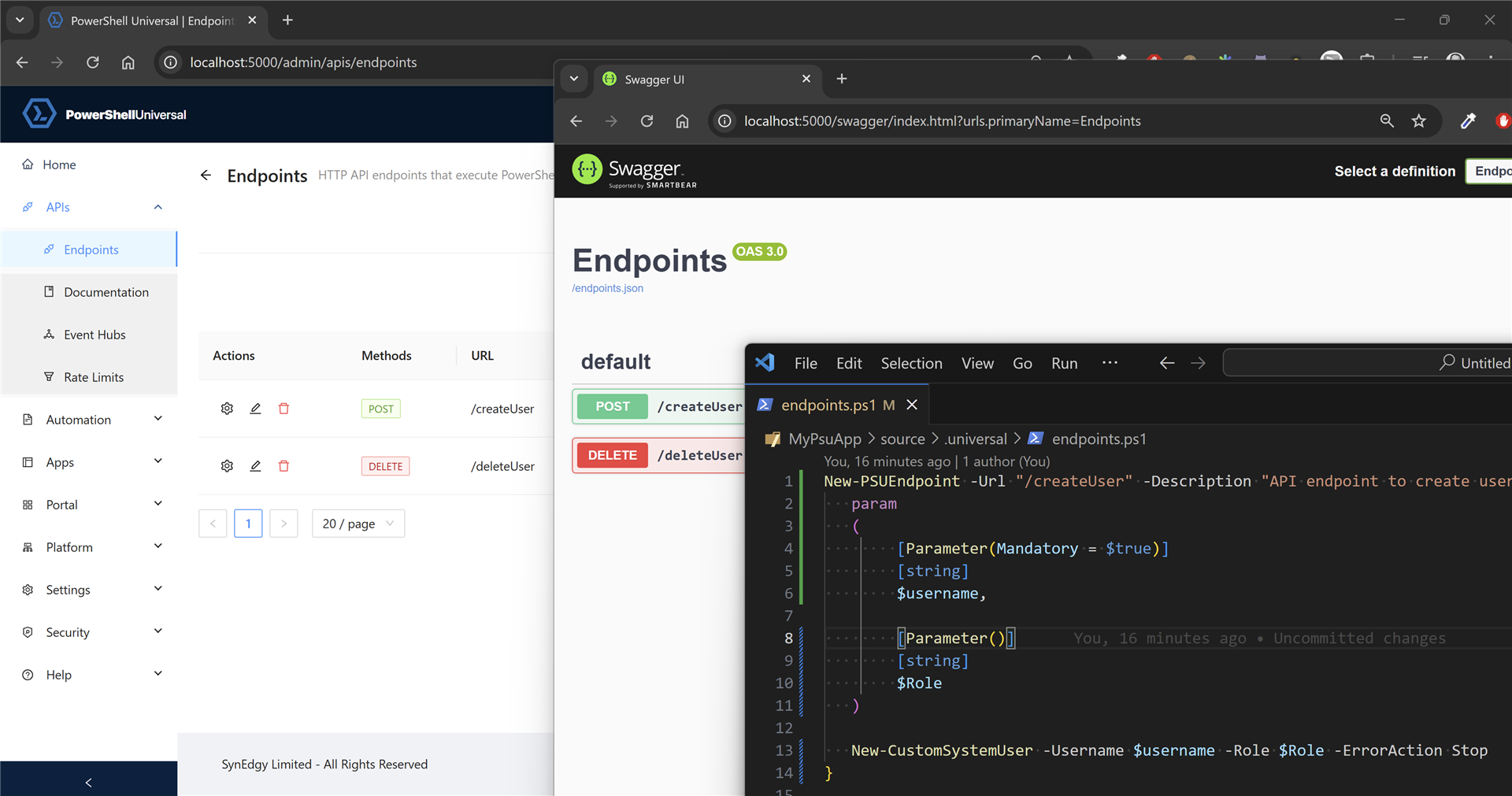
PowerShell Universal can turn PowerShell expertise into discoverable APIs, dashboards, automation workflows, and operational tools. The platform becomes far more valuable when its resources are versioned, packaged, tested, and deployed through the same engineering discipline as the modules they use.
SynEdgy develops public tooling that demonstrates this approach:
- Sampler.PowerShellUniversalTasks provides reusable packaging, deployment, offline repository, installation, and deployment-validation tasks for PowerShell Universal modules.
- synedgy.universal.helper provides declarative attributes for PowerShell Universal resources and reusable dashboard components, including job summaries and terminal-style job output.
This experience supports platform design as well as the less visible work that makes a PowerShell Universal environment maintainable after launch.
Desired State Configuration and configuration as code
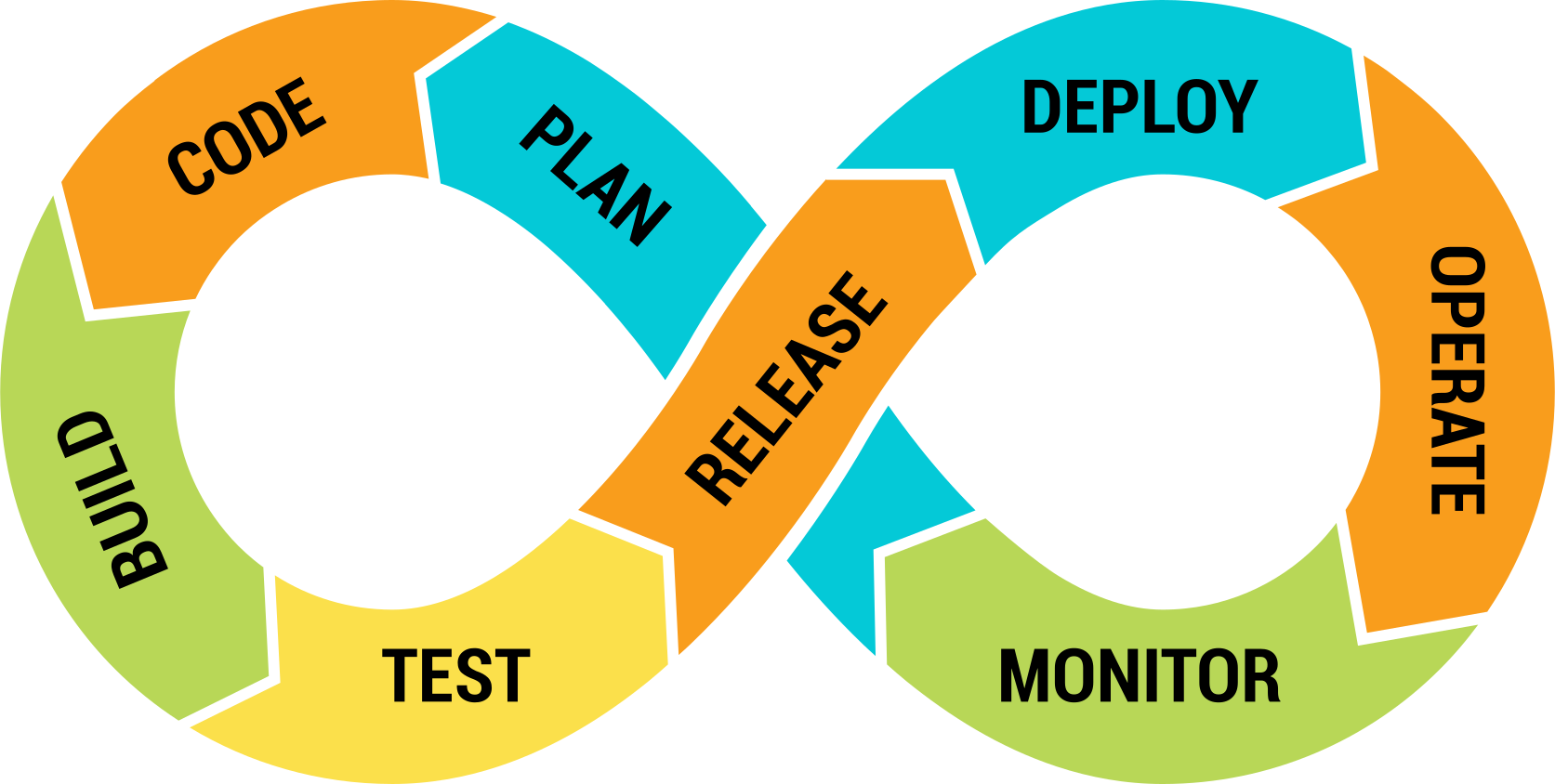
Desired State Configuration is most useful when it is part of a complete delivery system: configuration data, dependency resolution, automated testing, artifact creation, release pipelines, deployment, and reporting.
DscWorkshop is a practical blueprint for this wider model. It was initiated by Gael Colas and substantially expanded by Raimund Andree and Jan-Hendrik Peters within the DSC Community.
The project uses Datum for hierarchical configuration data and demonstrates how DSC can fit into an automated, testable, and repeatable release process.
Public sessions such as Configuring Azure Entra ID and M365 with DSC and Writing DSC Resources for Azure Policy Guest Configuration - For Linux! show how these principles apply across Microsoft 365, Azure governance, and cross-platform configuration.
Git collaboration and DevOps for ITOps
Infrastructure and operations teams increasingly build internal products: modules, APIs, automation services, dashboards, integrations, and configuration systems.
Git, reviews, automated testing, CI/CD, and release discipline are not software development rituals added for their own sake. They help operational teams share knowledge, reduce risk, and improve changes continuously.
The Mastering git collaboration - A DevOps necessity session explores the collaboration habits and workflows behind that shift.
Chocolatey and enterprise package management
Package management becomes an operational capability when software distribution, internal repositories, configuration, approvals, testing, and maintenance are treated as one system.
Gael Colas authored the community-governed Chocolatey PowerShell module while serving SynEdgy customers, with SynEdgy sponsoring that engineering work. The module and related DSC resources provide public evidence of practical Chocolatey automation experience.
SynEdgy’s expertise extends beyond installing packages. It includes the engineering and governance needed to make enterprise software distribution repeatable, auditable, and supportable.
Modern infrastructure and platform integration
Modern IT environments combine cloud services, on-premises infrastructure, identity systems, Modern Workplace platforms, APIs, package repositories, and specialised operational tools.
The challenge is not simply knowing each technology. It is creating coherence between them without introducing tight coupling or an automation estate that becomes harder to change than the systems it replaced.
SynEdgy uses modular automation, configuration as code, APIs, dashboards, and delivery pipelines to help teams integrate these environments around the outcomes they need.
Expertise should remain useful
Technical depth matters, but a list of technologies is not the outcome.
Our goal is to help teams:
- Reduce operational toil
- Make automation easier to understand and change
- Improve delivery flow and release confidence
- Share knowledge beyond individual specialists
- Build capability that remains within the organisation
Detailed technical guidance belongs in Articles, where examples, trade-offs, limitations, and production considerations can be explored properly.